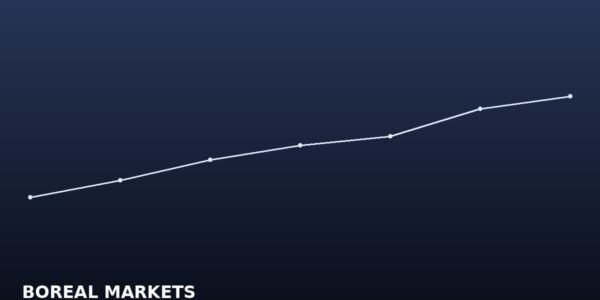
- Lithium Americas (LAC) held flat at $2.63 USD ($3.73 CAD) on October 1, 2026, while Albemarle fell 1.71% to $105.78, reflecting continued sector-wide price pressure.
- Canada’s IRA-aligned Critical Minerals Agreement gives Canadian lithium producers a structural tariff and tax-credit advantage over South American and Australian competitors.
- Direct lithium extraction pioneers Standard Lithium (SLI.V) and E3 Lithium (ETL.V) offer TSX-V investors exposure to a technology that could dramatically cut production costs and timelines.
- Global EV sales are forecast to top 20 million units in 2026, but lithium carbonate spot prices near US$12,000 per tonne remain far below levels needed to incentivize new large-scale supply.
Lithium Americas (LAC) closed flat at $2.63 on October 1, 2026 — approximately $3.73 CAD at the prevailing USD/CAD rate of 1.4183 — a sign of stubborn consolidation in a sector that has shed enormous value from its 2022 peak. Albemarle (ALB), the world’s largest lithium producer, slipped 1.71% to $105.78 (roughly $150.02 CAD), while the Global X Lithium & Battery Tech ETF (LIT) dipped 0.18% to $68.42. The message from the market is blunt: lithium’s recovery story remains a promise, not yet a payday.
Thacker Pass: Canada’s Proxy Play on U.S. Lithium Independence
Lithium Americas’ flagship Thacker Pass project in Nevada remains one of the most watched lithium developments in North America. Though the asset sits in the United States, the company trades in Toronto and is deeply integrated into Canada’s critical minerals investment ecosystem. Phase 1 of Thacker Pass is designed to produce 40,000 tonnes of battery-grade lithium carbonate per year, enough to supply roughly 800,000 electric vehicles annually. General Motors’ offtake agreement and equity investment — totalling US$650 million committed — gives the project institutional credibility that few junior peers can match. For Canadian retail investors, LAC’s flat close is less a red flag than a reflection of the broader sector malaise.
IRA Provisions Are Rewriting Canadian Supply Chain Math
The U.S. Inflation Reduction Act’s critical minerals provisions continue to create a structural tailwind for Canadian lithium developers. Under the Canada-U.S. free trade framework and the bilateral Critical Minerals Agreement, lithium sourced and processed in Canada qualifies for IRA EV tax credit eligibility — a competitive advantage that jurisdictions like Argentina, Chile, and Australia cannot easily replicate. Ottawa has doubled down with its own Critical Minerals Strategy, allocating over $3.8 billion CAD to support extraction, processing, and battery supply chain development through 2030. The policy scaffolding is in place; execution is what the market is waiting on.
Direct Lithium Extraction: The Technology That Could Change Everything
Direct lithium extraction (DLE) technology is quietly becoming the sector’s most consequential wildcard. Unlike conventional hard-rock or evaporation-pond methods, DLE can extract lithium from brines in hours rather than months, with a significantly smaller land footprint and lower water consumption. Standard Lithium (SLI.V), listed on the TSX Venture Exchange, is piloting DLE at its Arkansas project in partnership with Koch Industries, while E3 Lithium (ETL.V) is advancing a DLE-focused program targeting Alberta’s prolific Leduc aquifer system. Both names offer Canadian retail investors direct exposure to the technology shift without the sovereign risk of South American brine assets.
TSX-V Names Best Positioned for the Recovery
Beyond Standard Lithium and E3 Lithium, Frontier Lithium (FL.V) stands out for its PAK Lithium Project in Ontario’s Electric Vehicle supply chain corridor — one of the highest-grade hard-rock spodumene deposits in Canada. The company has secured provincial support and is advancing a prefeasibility study targeting battery-grade lithium hydroxide production. Snow Lake Lithium (LITOF/SNO) in Manitoba has also drawn attention for its ambition to build a fully integrated, carbon-neutral lithium hydroxide operation, though execution timelines have stretched.
| Company | Ticker | Exchange | Price (Oct 1, 2026) | Key Asset |
|---|---|---|---|---|
| Lithium Americas | LAC | NYSE/TSX | $2.63 USD ($3.73 CAD) | Thacker Pass, Nevada |
| Standard Lithium | SLI | TSX-V | N/A | Arkansas DLE Pilot |
| E3 Lithium | ETL | TSX-V | N/A | Leduc Aquifer, Alberta |
| Frontier Lithium | FL | TSX-V | N/A | PAK Project, Ontario |
The lithium sector is in a classic late-cycle accumulation phase: fundamentals are strengthening — global EV sales are projected to exceed 20 million units in 2026 — but spot prices for lithium carbonate remain depressed, hovering near US$12,000 per tonne, far below the US$80,000 peak of late 2022. Investors with a 12-to-24-month horizon and an appetite for volatility may find Canada’s TSX-V lithium bench among the most asymmetric risk-reward opportunities on any exchange in the world right now.