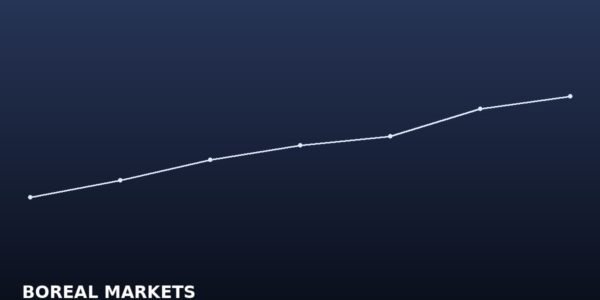
- Henry Hub natural gas fell 1.34% to $3.24/MMBtu ($4.61 CAD) on October 14, 2026, pressured by mild weather and above-average U.S. storage of roughly 3,612 Bcf.
- AECO spot prices remain approximately $1.10–$1.20/MMBtu below Henry Hub, keeping basis compression a persistent headwind for WCSB-exposed Canadian gas producers.
- Tourmaline Oil (TSX: TOU), Canada’s largest gas producer at ~2.2 Bcf/d, is using LNG Canada export contracts to access Asian JKM prices near $14/MMBtu, far above domestic benchmarks.
- AI datacenter construction could add 3–5 Bcf/d of incremental North American gas demand by 2028, providing a structural long-term price floor that favors low-cost Canadian producers.
Henry Hub natural gas futures dropped 1.34% to $3.24/MMBtu on October 14, 2026, weighed down by mild autumn temperatures across much of North America and a storage trajectory that remains comfortably above five-year seasonal averages. At the prevailing USD/CAD exchange rate of 1.4241, that translates to roughly $4.61/MMBtu in Canadian dollar terms — a level that still supports profitable operations for the country’s lowest-cost gas producers, but leaves little margin for higher-cost plays.
AECO Basis Stays Compressed
The AECO spot price in Alberta — the primary pricing benchmark for Canadian natural gas — continued to trade at a significant discount to Henry Hub, with the basis differential holding near USD $1.10–$1.20/MMBtu as pipeline egress constraints out of the WCSB (Western Canadian Sedimentary Basin) persist. That puts AECO in the range of approximately $2.04–$2.14/MMBtu USD ($2.90–$3.05 CAD). For producers heavily exposed to AECO — including Tourmaline Oil Corp. (TSX: TOU), Canada’s largest natural gas producer — the compressed basis underscores why diversified market access, particularly via LNG exports, has become a strategic imperative.
Tourmaline’s LNG Canada Exposure Is the Differentiator
Tourmaline holds contracted volumes tied to LNG Canada’s Phase 1 export terminal in Kitimat, B.C., which reached commercial operations earlier in 2026 and is now exporting liquefied natural gas to Asian markets at prices broadly linked to the Japan Korea Marker (JKM). JKM has been trading in the USD $13–$15/MMBtu range through Q3 2026, offering a dramatic premium over both Henry Hub and AECO. Tourmaline’s ability to place a portion of its roughly 2.2 Bcf/d of production into LNG-linked contracts effectively insulates a slice of its revenue from the chronic AECO discount that has historically punished Canadian gas producers. Management has indicated LNG-exposed volumes will grow as Phase 2 sanctioning discussions advance.
AI Datacenters Emerge as a Structural Demand Catalyst
Beyond LNG, a newer and increasingly discussed demand driver is the explosion in AI datacenter construction across North America. Hyperscalers including Microsoft, Google, and Amazon have announced or broken ground on a combined several gigawatts of new compute capacity in 2025–2026, much of it powered by gas-fired generation given the lag in grid-scale renewable buildout. Industry analysts estimate that AI and high-performance computing load growth could add 3–5 Bcf/d of incremental U.S. gas demand by 2028 — a figure that would meaningfully tighten the North American supply-demand balance and provide a floor under Henry Hub prices. Canadian producers with spare deliverability, including Tourmaline and ARC Resources (TSX: ARX), are well-positioned to capture this demand uplift.
Storage Picture Keeps a Lid on the Upside — For Now
The latest EIA weekly storage report showed U.S. natural gas inventories at approximately 3,612 Bcf, sitting roughly 4.8% above the five-year average for this time of year. That surplus is the primary reason today’s price action leaned bearish despite the constructive longer-term narrative. Weather models for the coming two weeks show near-normal heating demand across the U.S. Midwest and Canadian Prairies, offering little near-term catalyst for a sharp price reversal. The setup, however, favors patient bulls: any early-winter cold snap or LNG feedgas pull increase could rapidly erode the storage cushion and push Henry Hub back toward the $3.50–$3.75/MMBtu range that analysts at TD Securities and RBC Capital Markets project for Q1 2027.
| Benchmark | Price (USD/MMBtu) | Price (CAD/MMBtu) | Day Change |
|---|---|---|---|
| Henry Hub Spot | $3.24 | $4.61 | -1.34% |
| AECO Spot (est.) | ~$2.09 | ~$2.98 | — |
| JKM (Asia LNG) | ~$14.00 | ~$19.94 | — |
For Canadian investors, the near-term softness in Henry Hub and AECO is less important than the structural story: LNG Canada’s export ramp, rising AI-driven power demand, and Canada’s position as the world’s third-largest natural gas reserve holder collectively underpin a multi-year demand expansion thesis. Tourmaline, with its scale, low cost structure, and LNG-linked contracts, remains the blue-chip expression of that thesis on the TSX.