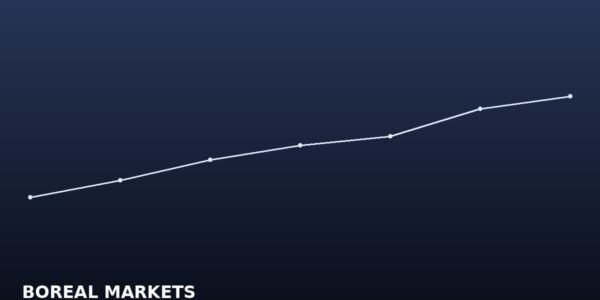
- Lithium Americas (LAC) jumped 6.33% to $3.19 USD ($4.39 CAD) on September 10, 2026, sharply outperforming Albemarle and the LIT ETF.
- IRA critical minerals provisions grant Canadian-processed lithium near-domestic status in U.S. EV supply chains, creating a durable policy premium for North American developers.
- Global EV sales reached 8.3 million units in H1 2026, up 14% year-over-year, underpinning projected demand of over 200,000 tonnes LCE from North America alone by 2028.
- TSX-V developers Patriot Battery Metals, Frontier Lithium, and peers in Quebec and Ontario are best positioned given DLE technology adoption and proximity to U.S. gigafactory corridors.
Lithium Americas Corp. (NYSE: LAC) surged 6.33% to $3.19 USD ($4.39 CAD) on September 10, 2026 — a sharp divergence from the broader lithium complex, where Albemarle (NYSE: ALB) fell 2.82% to $125.91 USD and the Global X Lithium & Battery Tech ETF (NYSE: LIT) was nearly flat at $73.77 USD. The split tells an important story: investors are rotating out of large, globally diversified lithium producers and into North American-focused developers whose supply chains carry a structural policy premium.
Thacker Pass: The IRA Wildcard
The catalyst behind LAC’s move is almost certainly tied to ongoing developments at its Thacker Pass project in Nevada — the largest known lithium deposit in the United States. Under the Inflation Reduction Act’s critical minerals provisions, battery-grade lithium sourced from Free Trade Agreement partners qualifies for EV tax credit eligibility. Canada and the U.S. share a critical minerals agreement that extends similar “domestic” treatment to Canadian-processed lithium, meaning any Canadian refining or processing node in the Thacker Pass supply chain carries real commercial value. That policy linkage is increasingly being priced in.
Lithium Prices: Oversupply Hangover, But a Floor Is Forming
Lithium carbonate prices have been suppressed through most of 2025 and into 2026, weighed down by Chinese spodumene inventory builds and slower-than-expected EV adoption in Europe. Albemarle’s 2.82% decline today reflects that ongoing margin pressure — the company has guided for lower realized pricing through late 2026. However, analysts at BMO Capital Markets and National Bank Financial have flagged that the market may be approaching a cyclical floor, with Chilean and Australian production curtailments beginning to tighten the spot supply picture heading into 2027.
Global EV sales hit approximately 8.3 million units in the first half of 2026, up 14% year-over-year, with North American volumes accelerating as IRA-compliant models multiply on dealer lots. Each EV requires roughly 8–10 kg of lithium carbonate equivalent (LCE) in its battery pack. At projected H2 2026 run rates, that translates to incremental annual demand of more than 200,000 tonnes LCE from North America alone by 2028 — demand that today’s domestic supply pipeline cannot fully meet.
Direct Lithium Extraction: Canada’s Technological Edge
One underpublicized competitive advantage for Canadian developers is the accelerating commercialization of Direct Lithium Extraction (DLE) technology. Unlike conventional evaporation pond methods, DLE uses ion-exchange or solvent extraction to recover lithium from brines in hours rather than months, with a significantly smaller environmental footprint. Alberta’s oilfield brines, long considered a curiosity, are now being evaluated by multiple juniors as DLE costs fall toward commercial viability. This positions Canadian companies at the intersection of resource endowment and technology leadership.
TSX-V Names Worth Watching
For retail investors seeking leveraged exposure to a lithium recovery, several TSX-V listed explorers stand out for their project quality and IRA-adjacent positioning:
| Company | Exchange | Project Focus | Key Catalyst |
|---|---|---|---|
| Patriot Battery Metals (PMET) | TSX-V | Shaakichiuwaanaan, Quebec (spodumene) | Resource expansion drilling, major partner offtake |
| Frontier Lithium (FL) | TSX-V | PAK Project, Ontario | Feasibility study, Ontario critical minerals funding |
| Winsome Resources (WR) | TSX-V | Adina, Quebec | DLE-compatible brine assessment, resource update |
| Lomiko Metals (LMR) | TSX-V | La Loutre, Quebec | Provincial permitting milestone |
Quebec and Ontario remain the most favoured jurisdictions, benefiting from provincial critical minerals strategies, low-carbon hydroelectric power grids — a key differentiator for battery-grade refining economics — and proximity to U.S. gigafactory corridors in Georgia, Tennessee, and Michigan. Canada’s critical minerals advantage is not just geological; it is logistical, political, and increasingly technological. Today’s price action in LAC suggests the market is starting to agree.