

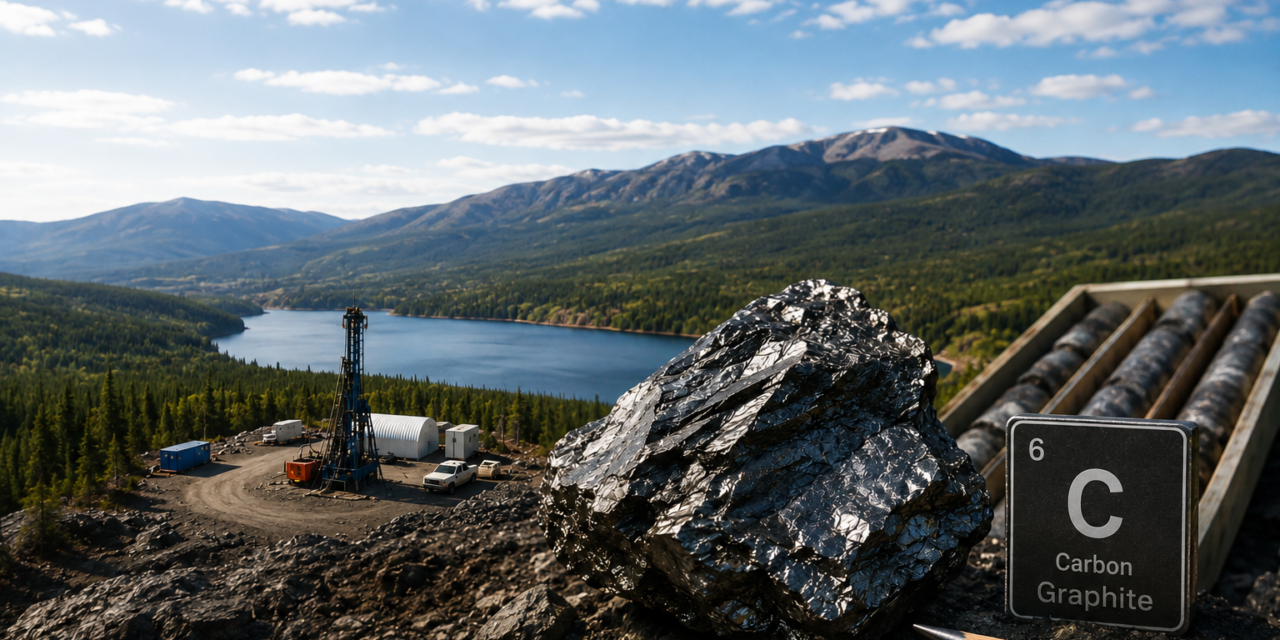
Graphite has been getting a lot more attention lately, and Canadian investors have had some pretty compelling reasons to notice.
One example is HydroGraph Clean Power Inc. (CSE: HG) (OTCQB: HGRAF). The graphene producer has become one of the more closely watched Canadian-listed names in the broader graphite and advanced-materials space following a significant move in its shares. Investing News Network recently ranked HydroGraph among its top Canadian graphite stocks for 2026 and reported a year-to-date gain of more than 1,300% at the time of publication.
HydroGraph isn’t a conventional graphite miner; it manufactures high-purity graphene using a patented process that uses acetylene and oxygen rather than mined graphite, but its rise has helped put a spotlight on the broader carbon-materials opportunity.
And it got me thinking.
What is happening with graphite itself?
We constantly hear about lithium, uranium, copper, and gold, but graphite doesn’t always receive the same attention from retail investors. Yet graphite is an important material for lithium-ion batteries and could have growing relevance across energy storage, industrial applications and defence.
There is also a geopolitical component.
According to First Canadian Graphite CEO John LaGourge, China currently accounts for approximately 80% to 90% of global graphite processing. He also told me graphite can account for up to 30% of an EV battery.
That raised an obvious question for me as an investor:
If Canada and the U.S. continue trying to secure domestic critical-mineral supply chains, could graphite be one of the next commodities to capture significantly more investor attention?
That’s what led me to First Canadian Graphite Corporation.
The company is advancing a graphite exploration project in Quebec and recently identified a large electromagnetic target known as Zone 13.
I was curious about the company as a potential investment, but before forming an opinion, I wanted to better understand both sides of the story: Why graphite, and what could First Canadian Graphite actually have on its hands?
So I reached out directly to the CEO, John LaGourge, and asked him to walk me through it.
What Caught My Attention About First Canadian Graphite
First Canadian Graphite has been in existence for approximately a decade, but LaGourge represents new management. He told me he became involved in late 2025 and subsequently raised capital to begin advancing the company’s Quebec project more aggressively.
FCI flew an airborne electromagnetic (EM) survey over their claims, which had never previously been explored. This led the company to a significant new discovery area it calls Zone 13.
According to LaGourge, the anomaly currently measures approximately four kilometres along strike and up to 600 metres wide, while initial geophysical interpretation suggests it could extend to depths of approximately 200 metres.
Those dimensions caught my attention, but they’re also important to put into context.
A large geophysical anomaly is not the same thing as a defined mineral resource. Further exploration and drilling should help determine the extent, continuity and grade of any graphite mineralisation.
That’s what makes the next stage interesting.
Could Grade Become an Advantage?
Grade is another part of the story I’m watching.
LaGourge told me many graphite deposits globally average approximately 5% to 6%, while the company’s broader Quebec district has demonstrated considerably higher grades in certain areas.
First Canadian Graphite has also completed early field sampling. According to LaGourge, some samples returned assays of up to 43% graphite.
Individual high-grade samples don’t mean Zone 13 averages 43%, nor do they establish an economic resource. But they could provide another reason to investigate the target.
If future drilling demonstrates substantial tonnage with consistently attractive grades, it could potentially have implications for project economics. Higher grades may allow more graphite to be recovered from the same amount of processed material, although metallurgy, recoveries, capital requirements and numerous other factors would ultimately need to be considered.
Why Quebec Could Matter
The project is located in Quebec’s Manicouagan region, north of Baie-Comeau.
LaGourge told me the property benefits from year-round road access and is approximately 50 kilometres from the Manic-5 hydroelectric facility and associated Hydro-Québec infrastructure. Baie-Comeau also provides access to port and rail infrastructure.
None of these factors guarantees that a future mine will be economic, but existing roads, electricity, and transportation infrastructure could reduce some of the development challenges faced by more remote exploration projects.
Quebec’s broader push to develop its critical-minerals sector could provide another potential tailwind.
The Catalyst I’m Watching: Drilling
For me, the most important part of this story is what happens next.
The company has completed fieldwork, collected samples and, according to LaGourge, sent metallurgical samples to Corem for testing.
Additional EM surveying is planned to better define Zone 13, followed by 3D modelling and further surface exploration.
Then comes the major test:
Drilling.
LaGourge told me the company is targeting drilling around November and discussed a potential 20,000-metre drill program.
He suggested that if the asset performs as management hopes, a program of that scale could potentially support defining up to approximately 50 million tonnes.
To be clear, that is not a current mineral resource. It represents management’s view of what could potentially be achievable if future exploration supports its geological interpretation.
That’s exactly why the drilling matters.
If the results demonstrate scale, continuity, and attractive grades, the company could progress toward a formal mineral resource estimate. If they don’t, the investment thesis would need to be reassessed.
What I’ll Be Watching
During our interview, we discussed First Canadian Graphite, which has a market capitalisation of approximately C$18 million to C$20 million.
A relatively small valuation can provide significant leverage to exploration success, but it also reflects the risks associated with an early-stage company that still has to prove its resource.
Rather than trying to predict the outcome, I’m watching a few key questions:
How large is Zone 13? Are the high grades repeatable? What does the metallurgy show? And can management execute on its exploration timeline?
But I’m also watching graphite itself.
Stocks such as HydroGraph have shown that Canadian investors are paying attention to opportunities in advanced carbon materials. HydroGraph’s story is very different from that of a graphite explorer, but the investor interest surrounding the company made me want to better understand the upstream graphite opportunity as well.
If Canada and the U.S. continue to prioritise secure critical-mineral supply chains while demand from batteries, energy storage, defence and other applications grows, graphite could become much more visible to Canadian investors.
First Canadian Graphite still has plenty to prove.
But that’s also what makes the next stage interesting.
I’ll be watching the drill results.
Disclosure & Disclaimer
I independently reached out to First Canadian Graphite Corporation and its CEO, John LaGourge, to learn more about the company and the graphite sector. No fee or compensation was paid by First Canadian Graphite Corporation for this interview or resulting editorial coverage.
This article is for informational and educational purposes only and does not constitute investment advice or a recommendation to buy or sell any security. Statements concerning First Canadian Graphite’s properties, grades, exploration targets, potential tonnage, future resources, economics and timelines are primarily based on comments made by company management during my interview and have not been independently verified by Boreal Markets unless otherwise stated.
Exploration targets, geophysical anomalies, historical resources and individual assay results should not be interpreted as current mineral resources, reserves or evidence of an economically viable mine. Junior mining securities are speculative and can be highly volatile.
References to HydroGraph Clean Power are provided for market context only and should not be interpreted as suggesting that HydroGraph and First Canadian Graphite have equivalent businesses, assets or investment characteristics.
Readers should conduct their own due diligence, review each company’s official regulatory filings and continuous disclosure, and consult a qualified financial professional before making investment decisions. My views may change as new information becomes available.